IB Biology · Theme B of 4

IB Biology theme B: Form and function

11 ready-made review sets for this theme, by subtopic and marked SL or HL, plus 2 mixed review sets that run into it. Free to host, and students join with a code.

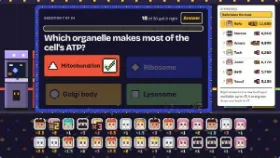
A question from the sets

General name for the covalent bond linking any two monosaccharides, formed by condensation?

  • Polysaccharide
  • Monosaccharide
  • Disaccharide
  • Glycosidic bondRight answer
From B1.1 Carbohydrates, 15 questions.

What Theme B covers

Theme B links structure to function at every scale. Molecules: carbohydrates, lipids and proteins. Cells: membranes and membrane transport, organelles and compartmentalization, and cell specialization. Organisms: gas exchange and transport, with muscle and motility at higher level. Ecosystems: adaptation to environment and ecological niches.

Where students slip

  • Condensation joins monomers and releases water; hydrolysis uses water to split them.
  • Saturated fatty acids have only single bonds between their carbon atoms; unsaturated fatty acids have at least one carbon-carbon double bond.
  • Ventilation, gas exchange and cell respiration are three different things.
  • Arteries carry blood away from the heart, and it is not always oxygenated: the pulmonary artery carries deoxygenated blood to the lungs.
  • A niche is not just where a species lives. The fundamental niche is the full range of conditions and resources it could use; the realized niche is the part it actually uses once competitors are present.

The sets

Play this set opens the set in splycr, where you can read every question and host it for your class straight away. Hosting needs no account, and students join with the code on the board. A free account lets you copy a set and edit it.

The questions come from the Biology by Bradford flashcard bank, written by an IB and AP Biology teacher. Each one plays as multiple choice, and the wrong options are other answers from the same set.

Sets marked SL suit every IB Biology student, because higher level students study the standard level content too. Sets marked HL cover the additional higher level material, and six subtopics are for higher level only: A2.1, A2.3, A3.2, B3.3, C2.1 and D2.2. Some sets are marked SL and HL, and cover both.

B1 · Molecules

B1.1 Carbohydrates and lipids

B1.1 Carbohydrates

15 questionsSL

  1. General name for the covalent bond linking any two monosaccharides, formed by condensation?

    Answer: Glycosidic bond

  2. Structural beta-glucose polymer found in plant cell walls?

    Answer: Cellulose

  3. What type of glycosidic bond creates a branch point in a polysaccharide?

    Answer: 1,6 glycosidic bond

Play this setand 12 more questions

B1.1b Lipids

11 questionsSL

  1. What lipid is formed from one glycerol and three fatty acids?

    Answer: Triglyceride

  2. What term describes the bond linking fatty acids to glycerol in triglycerides?

    Answer: Ester bond

  3. Fatty acid with one or more C=C double bonds; liquid at room temp?

    Answer: Unsaturated fatty acid

Play this setand 8 more questions

B1.2 Proteins

B1.2 Proteins

17 questionsSL and HL

  1. The 3D folding of a single chain caused by R-group interactions?

    Answer: Tertiary structure

  2. A non-protein molecule tightly bound to a protein (e.g., the heme group)?

    Answer: Prosthetic group

  3. Strong covalent bond between the sulfur atoms of two cysteine residues?

    Answer: Disulfide bridge

Play this setand 14 more questions

B2 · Cells

B2.1 Membranes and membrane transport

B2.1 Membranes

10 questionsSL

  1. The model describing the membrane as a fluid bilayer with mobile, embedded proteins?

    Answer: Fluid mosaic model

  2. A steroid in animal membranes that regulates fluidity and stability?

    Answer: Cholesterol

  3. What term describes a molecule that has both hydrophilic and hydrophobic parts?

    Answer: Amphipathic

Play this setand 7 more questions

B2.1b Membrane transport

10 questionsSL

  1. Passive transport using channel or carrier proteins to move polar/large molecules?

    Answer: Facilitated diffusion

  2. Specialized channel proteins that allow for the rapid movement of water molecules?

    Answer: Aquaporins

  3. The movement of substances against a concentration gradient using energy (ATP)?

    Answer: Active transport

Play this setand 7 more questions

B2.2 Organelles and compartmentalization

No set of its own yet. The mixed review set B2.2–B3.2, below, includes some of it.

B2.3 Cell specialization

B2.3 Cell Specialization

13 questionsSL

  1. Stem cells that can differentiate into any cell type except the placenta?

    Answer: Pluripotent

  2. A red blood cell specialized for oxygen transport; lacks a nucleus to save space?

    Answer: Erythrocyte

  3. A plant cell packed with chloroplasts for maximum photosynthesis?

    Answer: Palisade mesophyll cell

Play this setand 10 more questions

B3 · Organisms

B3.1 Gas exchange

B3.1 Gas Exchange: Humans

14 questionsSL

  1. Extremely thin alveolar cells specialized to minimize diffusion distance?

    Answer: Type I pneumocyte

  2. Cuboidal alveolar cells that secrete pulmonary surfactant?

    Answer: Type II pneumocyte

  3. A condition where alveolar walls are destroyed, reducing surface area for gas exchange?

    Answer: Emphysema

Play this setand 11 more questions

B3.2 Transport

B3.2 Transport: Humans

10 questionsSL

  1. The vessel that returns blood to the heart; contains valves to prevent backflow?

    Answer: Vein

  2. The heart's natural pacemaker located in the right atrium?

    Answer: Sinoatrial (SA) node

  3. The arteries that supply the heart muscle itself with oxygen and nutrients?

    Answer: Coronary arteries

Play this setand 7 more questions

B3.3 Muscle and motilityHL only

B3.3 Muscle and Motility

10 questionsHL

  1. The basic functional and contractile unit of skeletal muscle?

    Answer: Sarcomere

  2. The modified ER in muscle cells that stores and releases calcium ions?

    Answer: Sarcoplasmic reticulum

  3. The protein that blocks myosin-binding sites on actin when the muscle is relaxed?

    Answer: Tropomyosin

Play this setand 7 more questions

B4 · Ecosystems

B4.1 Adaptation to environment

B4.1 Adaptation to Environment

11 questionsSL

  1. A plant adapted to survive in extremely dry conditions?

    Answer: Xerophyte

  2. A plant adapted to survive in saline (salty) environments?

    Answer: Halophyte

  3. A graph that shows the relationship between temperature and precipitation in a biome?

    Answer: Climograph

Play this setand 8 more questions

B4.2 Ecological niches

B4.2 Ecological Niches

16 questionsSL

  1. The theoretical range of conditions and resources a species could use without competition?

    Answer: Fundamental Niche

  2. The actual range of conditions and resources a species does use due to competition?

    Answer: Realized Niche

  3. Organisms that secrete enzymes to externally digest dead organic matter before absorbing it?

    Answer: Saprotrophs

Play this setand 13 more questions

Mixed review sets

Each of these runs across several subtopics in syllabus order, from the first code in its title to the second. They suit a review at the end of a theme.

B2.2–B3.2 Organelles, Gas Exchange & Transport

20 questionsSL and HL

  1. What is the protein that coats the cytoplasmic side of a membrane to help it curve and form a vesicle?

    Answer: Clathrin

  2. The two specialized cells that surround a stoma and control its opening?

    Answer: Guard cells

  3. Specialized cells that provide metabolic support to phloem sieve tube elements?

    Answer: Companion cells

Play this setand 17 more questions

B3.2–C2.2 Plant Transport, Respiration & Neural Signalling

19 questionsSL and HL

  1. A polymer that strengthens xylem walls to prevent collapse under tension?

    Answer: Lignin

  2. Which enzyme synthesizes ATP as protons flow down their concentration gradient?

    Answer: ATP synthase

  3. What are the gaps in the myelin sheath where ion exchange occurs?

    Answer: Nodes of Ranvier

Play this setand 16 more questions

Game modes that suit this theme

Every set plays in all eight modes. These two fit this theme best.

  • Kaboom

    Form and function answers are short names (glycosidic bond, aquaporin, sarcomere), so the bomb moves quickly and everyone answers many times. Nobody is knocked out.

  • Splycr

    A streak raises the multiplier to 3× and one slip drops it to 1×. Fast answers score a little more, but a long streak counts for more, so it rewards the student who can match every structure to its function.

IB and AP are trademarks of their owners. splycr is not affiliated with or endorsed by the International Baccalaureate or the College Board.